6. Actuator-grid DM with baked-in misalignment
The actuator_grid corrector is an N×N influence-function deformable mirror driven by raw per-actuator commands — the command surface a hardware DM actually exposes, as opposed to the modal (Zernike) interface of the zernike corrector. Two influence models are available (gaussian and xinetics, via the matching HCIPy factories), and DM misalignment relative to the pupil is baked in at construction: rotation_deg rotates the influence-function geometry,
flip_x/flip_y mirror the command-array indexing (a mirrored cable/mapping). That makes this corrector the natural simulation stand-in for a real bench DM whose mounting and wiring a calibration routine must recover.
Command conventions (pinned by the unit tests):
set_actuatorsaccepts a flat(N²,)or shaped(N, N)array; a shaped command indexescmd[iy, ix]— axis 0 walks y ascending, axis 1 walks x ascending.Positive
rotation_degrotates the DM counterclockwise relative to the pupil (x right, y up) as seen in a plotted surface.Flips mirror the command indexing before the rotated geometry renders it (flip-then-rotate), and the
actuatorsreadback un-applies them, so callers always round-trip their own values.
This demo uses a realistic scale: a 50×50 actuator grid at 0.17 m projected pitch over an 8 m circular pupil (2500 actuators on a 256² grid — the influence-function basis is sparse, and building it takes a few seconds at bind time).
[1]:
import numpy as np
import matplotlib.pyplot as plt
from matplotlib.colors import LogNorm
import hcipy

from telescope_sim.config.schema import SimConfig
from telescope_sim.config.loader import build
from telescope_sim.helpers.diagnostics import plot_opd_and_psfs

config = {
    'pupil': {'resolution': 256, 'extent': 8.65},
    'aperture': {
        'type': 'external_pupil', 'mode': 'callable',
        'module': 'hcipy', 'function': 'make_circular_aperture',
        'kwargs': {'diameter': 8.0},
        'area': float(np.pi * 4.0 ** 2),
    },
    'correctors': {
        'dm': {
            'type': 'actuator_grid',
            'num_actuators': 50,
            'actuator_pitch': 0.17,
            'influence': 'gaussian',
            'rotation_deg': 3.5,
            'actuate_scale': 1.0e-6,   # caller units -> meters of surface
            'wavefront_role': 'actuate',
            'target_strategy': 'actuators', 'target': True,
        },
    },
    'corrector_chain': ['dm'],
    'focal_planes': {
        'filter1': {
            'type': 'angular', 'central_lam': 1.55e-6,
            'focal_extent': 1.6, 'focal_res': 128,
            'fractional_bandwidth': 0.0, 'num_samples': 1,
        },
    },
    'outputs': {
        'psf': {
            'tap': {'type': 'intensity', 'focal_planes': ['filter1']},
            'post_processing': [],
        },
    },
}
sim = build(SimConfig.model_validate(config))
dm = sim.correctors['dm']
print('n_actuators:', dm.n_actuators)
n_actuators: 2500
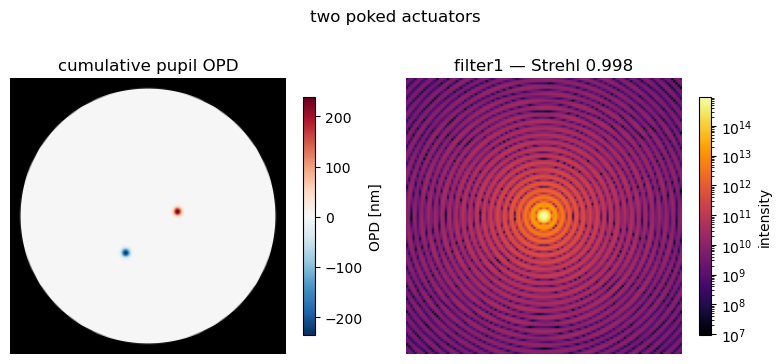
Poke two actuators (0.12 command units × actuate_scale = 120 nm of surface each) and sample. The OPD panel shows the two localized influence-function bumps; the PSF picks up the corresponding speckle structure.
[2]:
cmd = np.zeros((50, 50))
cmd[25, 30] = 0.12   # cmd[iy, ix]: y index 25, x index 30
cmd[18, 20] = -0.12

out_rest = sim.sample(meas_strehl=True, meas_pupil_opd=True)
out_poke = sim.sample(
    actuations={'dm': cmd}, meas_strehl=True, meas_pupil_opd=True,
)
print(f"Strehl at rest: {out_rest['strehls']['filter1']:.3f}")
print(f"Strehl poked:   {out_poke['strehls']['filter1']:.3f}")
plot_opd_and_psfs(sim, out_poke, suptitle='two poked actuators')
plt.show()
Strehl at rest: 1.000
Strehl poked:   0.998
Misalignment: rotation and command flips
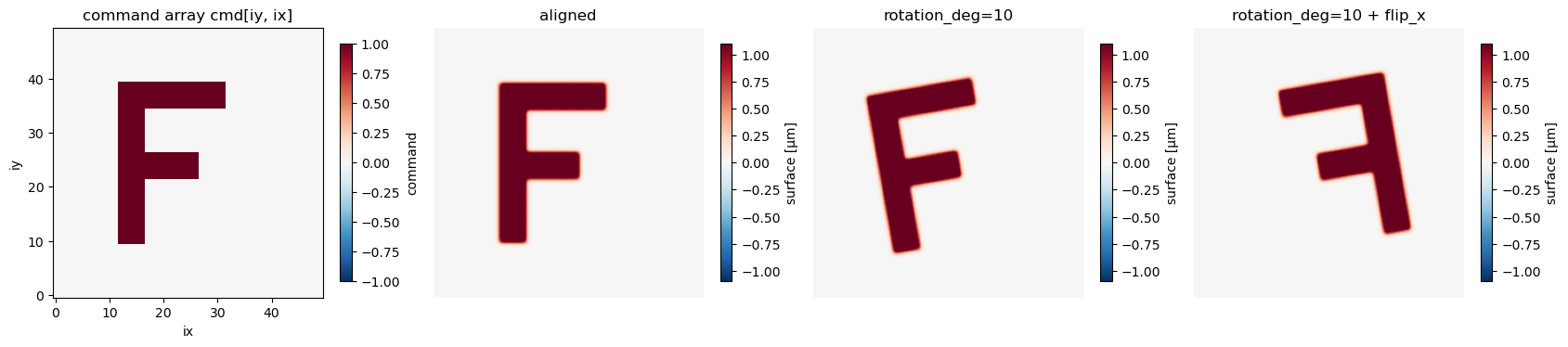
To make the conventions visible, render one asymmetric command pattern (a blocky letter F — unambiguous under both rotations and mirror flips) through three DM variants: aligned, rotated, and rotated + flip_x. The correctors are constructed directly and bound to the sim’s existing pupil grid — the same call the YAML loader makes at build time.
In the aligned panel the F reads normally (axis 0 of the command is y, so the top bar of the F is at high y). With rotation_deg=10 the whole surface turns counterclockwise. Adding flip_x mirrors the command indexing first, then the rotated geometry renders it — flip-then-rotate.
[3]:
from telescope_sim.correctors.actuator_grid import ActuatorGridCorrector

cmd_f = np.zeros((50, 50))
cmd_f[10:40, 12:17] = 1.0   # vertical stroke
cmd_f[35:40, 12:32] = 1.0   # top bar (high y)
cmd_f[22:27, 12:27] = 1.0   # middle bar

pupil_grid = sim.aperture.field.grid
variants = [
    ('aligned', {}),
    ('rotation_deg=10', {'rotation_deg': 10.0}),
    ('rotation_deg=10 + flip_x', {'rotation_deg': 10.0, 'flip_x': True}),
]

fig, axes = plt.subplots(1, 4, figsize=(17, 4))
im0 = axes[0].imshow(
    cmd_f, origin='lower', cmap='RdBu_r', vmin=-1, vmax=1,
)
axes[0].set_title('command array cmd[iy, ix]')
axes[0].set_xlabel('ix')
axes[0].set_ylabel('iy')
fig.colorbar(im0, ax=axes[0], shrink=0.7, label='command')

for ax, (label, kwargs) in zip(axes[1:], variants):
    dm_i = ActuatorGridCorrector(50, 0.17, actuate_scale=1.0e-6, **kwargs)
    dm_i._bind_pupil_grid(pupil_grid, sim.aperture.field)
    dm_i.set_actuators(cmd_f)
    plt.sca(ax)
    # (Tutorial code reaches into ._dm for the surface; library
    # code shouldn't.)
    im = hcipy.imshow_field(
        dm_i._dm.surface * 1e6, cmap='RdBu_r', vmin=-1.1, vmax=1.1,
    )
    ax.set_title(label)
    ax.set_axis_off()
    fig.colorbar(im, ax=ax, shrink=0.7, label='surface [µm]')
plt.tight_layout()
plt.show()
The readback stays in the caller’s frame — with flips active the DM-facing command is mirrored, but dm.actuators returns exactly what was set:
[4]:
dm_flipped = ActuatorGridCorrector(
    50, 0.17, actuate_scale=1.0e-6, flip_x=True, flip_y=True,
)
dm_flipped._bind_pupil_grid(pupil_grid, sim.aperture.field)
dm_flipped.set_actuators(cmd_f)
print('round-trip exact:',
      np.allclose(dm_flipped.actuators, cmd_f.reshape(-1)))
round-trip exact: True
Influence models: gaussian vs xinetics
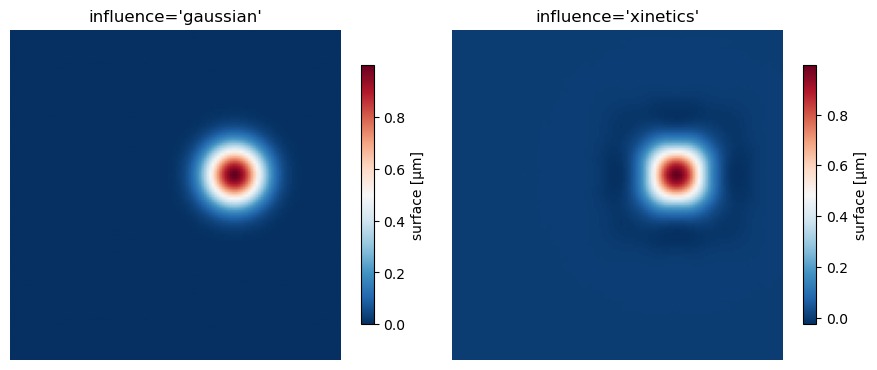
gaussian builds Gaussian pokes with a configurable nearest-neighbour crosstalk (default 0.15); xinetics uses HCIPy’s measured Xinetics actuator shape. Both accept the same misalignment parameters. A single poked actuator on a small demo grid shows the difference in footprint.
[5]:
mini_grid = hcipy.make_pupil_grid(128, 1.05)
mini_aper = hcipy.evaluate_supersampled(
    hcipy.make_circular_aperture(1.0), mini_grid, 4,
)
poke = np.zeros((8, 8))
poke[4, 5] = 1.0

fig, axes = plt.subplots(1, 2, figsize=(9, 4))
for ax, influence in zip(axes, ['gaussian', 'xinetics']):
    dm_i = ActuatorGridCorrector(
        8, 1.0 / 8, influence=influence, actuate_scale=1.0e-6,
    )
    dm_i._bind_pupil_grid(mini_grid, mini_aper)
    dm_i.set_actuators(poke)
    plt.sca(ax)
    im = hcipy.imshow_field(dm_i._dm.surface * 1e6, cmap='RdBu_r')
    ax.set_title(f'influence={influence!r}')
    ax.set_axis_off()
    fig.colorbar(im, ax=ax, shrink=0.7, label='surface [µm]')
plt.tight_layout()
plt.show()
Notes for real-DM workflows
actuate_scalecarries the caller-units → meters-of-surface calibration; commands stay in the units your control software already uses.Building the influence basis dominates sim construction (a few seconds for 50×50 on a 256² grid); per-sample cost is sub-millisecond. Build once, sample many times.
fit_surface(since v2.2.0) enables fit-role / residual-fit participation: the DM least-squares-fits any upstream OPD (an imposed corrector, or an atmosphere passed viasample(atmos=...)) onto its influence basis and the pipeline cancels it — ideal AO, fitting-error-limited. The fit is aperture-masked and mean-subtracted (piston is never commanded), with a tiny Tikhonov term pinning unilluminated actuators near zero.